
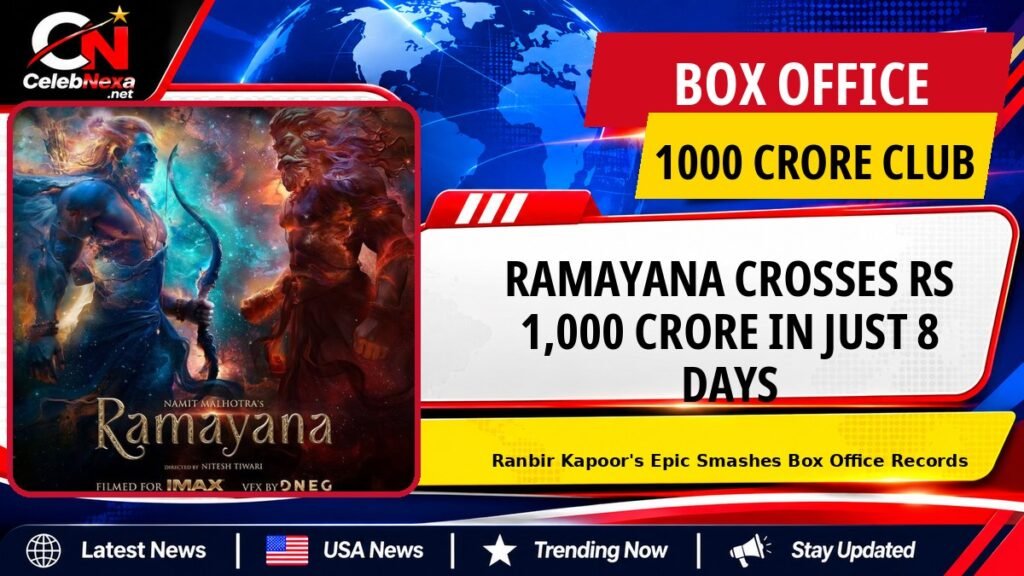
Ramayana Crosses Rs 1,000 Crore Worldwide in Eight Days, Reports Say
Ramayana: Part 1 has crossed Rs 1,000 crore at the worldwide box office in just eight days, according to new figures reported on November 13.
The numbers come from industry tracker Sacnilk, as reported by Times Now. They have not been released as official figures by the film’s producers, so they should be read as reported estimates rather than a studio announcement.
That distinction matters, and it is worth keeping in mind through the rest of this article. Every box-office figure below is a Sacnilk figure, as reported by Times Now. Different trackers can report slightly different totals, and the producers have not issued official figures. What follows is what the tracker reported, and what that reporting means.
On that reporting, the film collected Rs 53.50 crore net in India on its eighth day, across 24,042 shows. That took its total India net collection to Rs 564.60 crore, with a domestic gross of Rs 675.05 crore.
Overseas, the film earned Rs 25 crore on day eight, taking its total overseas gross to Rs 358.50 crore. Combined with the domestic gross, that pushed its worldwide gross to Rs 1,033.55 crore.
Eight days in, Ramayana has already joined the small group of Indian films to pass Rs 1,000 crore worldwide. The speed of that run is the story, and it is the reason the film is being talked about well beyond its opening weekend.
What Happened
Ramayana: Part 1 completed its first week in theatres and continued its strong run into its second week, according to Times Now, which reported the day-eight figures on November 13, 2026.
The report, authored by Mudit Bhatnagar and updated on November 13, 2026, at 00:17 IST, said the film added Rs 50 crore plus to its India total on day eight, taking it past Rs 550 crore in India.
More precisely, according to Sacnilk figures reported by Times Now, Ramayana collected Rs 53.50 crore net in India on day eight, across 24,042 shows. That took its total India net collection to Rs 564.60 crore. Its domestic gross collection currently stands at Rs 675.05 crore.
The Hindi version remained the biggest contributor on day eight, earning Rs 43 crore from 19,464 shows. The Kannada version collected Rs 3.25 crore, while the Malayalam version added Rs 2.80 crore to the total. The Telugu version earned Rs 2.30 crore, whereas the Tamil version collected Rs 2.15 crore on Thursday.
Overseas, the film earned Rs 25 crore on day eight, taking its total overseas gross to Rs 358.50 crore. Combined with the domestic gross of Rs 675.05 crore, that pushed its worldwide gross to Rs 1,033.55 crore.
On the reported figures, Ramayana is now the second Hindi film of 2026 to pass Rs 1,000 crore worldwide, after Ranveer Singh’s Dhurandhar 2.
It has also passed a personal milestone for its lead star. With Rs 564.60 crore net in India, Ramayana has overtaken Animal as the highest-grossing Ranbir Kapoor film. Animal had collected Rs 553.87 crore net and Rs 658.97 crore gross in its lifetime run, according to the same report.
Who Is Involved
Ramayana: Part 1 is directed by Nitesh Tiwari and produced by Namit Malhotra.
It stars Ranbir Kapoor as Lord Rama, Sai Pallavi as Sita, and Yash as Ravana. The cast also includes Sunny Deol, Ravie Dubey, Lara Dutta, and Arun Govil, according to Times Now.
That casting is central to how the film has been presented. Ranbir Kapoor, in the role of Rama, carries the film as its lead. Sai Pallavi, as Sita, plays the other central figure in the story. Yash, as Ravana, plays the antagonist, a role that has been widely discussed in the build-up to the film’s release.
The supporting cast adds familiar names in important roles, and the film’s scale — a mythological epic, released in five languages — depends on that cast being recognisable to audiences across India, not just in one language market.
The director, Nitesh Tiwari, and the producer, Namit Malhotra, are the two names most closely associated with the film’s production. Tiwari directed the film. Malhotra produced it. Together, they are responsible for bringing a story that has been told for centuries to the screen in this form, at this scale.
When It Happened
Ramayana: Part 1 was released in theatres on November 5, 2026, in Hindi, Tamil, Telugu, Kannada, and Malayalam.
The day-eight figures were reported on November 13, 2026.
The film’s opening week, as reported, looked like this. It opened on November 5 with Rs 64.85 crore net in India, followed by Rs 48.05 crore on day two. It then rose over the weekend, collecting Rs 69.80 crore on Saturday and Rs 56.15 crore on Sunday.
The biggest single day came on Monday, November 9, when the film earned Rs 107.50 crore net, helped by the post-Diwali holiday period. It followed that with Rs 94.10 crore on Tuesday and Rs 70.65 crore on Wednesday.
Day eight, Thursday, brought Rs 53.50 crore net in India, taking the total India net collection to Rs 564.60 crore.
That day-by-day pattern is worth looking at closely, because it tells us more than the total alone. The film did not just open big and then fade. It opened big, it held over the weekend, and then it rose sharply on Monday, in the post-Diwali holiday period. That Monday figure — Rs 107.50 crore net in a single day — is the largest day in the run so far, as reported, and it is the day that pushed the film’s momentum into its second week.
Background: The Story and the Film
The Ramayana is one of the great epics of India, a story that has been told and retold for centuries, in many languages, in many forms, and to many generations. At its centre are Rama and Sita, and the conflict with Ravana. That story is familiar to audiences across India, and it is a story that carries a great deal of cultural weight.
Making a film of the Ramayana, therefore, is not like making a film of a new story. The audience already knows the outline. They know who Rama is, who Sita is, and who Ravana is. What they do not know is how this particular film will tell that story — how it will look, how it will sound, how the characters will be played, and how the epic scale of the story will be brought to the screen.
Ramayana: Part 1 is, as its title makes clear, the first part of a larger telling. A sequel has been reported for Diwali 2028, but that is a future release, not part of the current box-office run.
The film was released in five languages — Hindi, Tamil, Telugu, Kannada, and Malayalam — and that decision is reflected in the day-eight figures. The Hindi version was the biggest contributor, earning Rs 43 crore on day eight, but the other language versions together added a substantial amount: Kannada Rs 3.25 crore, Malayalam Rs 2.80 crore, Telugu Rs 2.30 crore, and Tamil Rs 2.15 crore.
That spread matters. It shows that the film is not performing in one language market alone. It is performing across language versions in the same release, which is rare for a Bollywood title, and it is part of why the worldwide total has grown as quickly as it has.
The post-Diwali holiday period also matters to the run. The film was released on November 5, and its opening week was helped by that holiday period, including the sharp rise on Monday, November 9. Holidays can help a film in a simple way: more people have time to go to the cinema, and a film that is already being talked about can benefit from that extra audience.
Why This Matters
The Rs 1,000 crore figure matters because very few Indian films reach it, and even fewer reach it in eight days.
On the reported figures, Ramayana is the second Hindi film of 2026 to pass Rs 1,000 crore worldwide, after Ranveer Singh’s Dhurandhar 2. That puts it in a small group, and it puts it there quickly.
It also matters for Ranbir Kapoor. With Rs 564.60 crore net in India, Ramayana has overtaken Animal as the highest-grossing Ranbir Kapoor film. Animal had collected Rs 553.87 crore net in India over its lifetime run, according to the same report. For an actor, that kind of milestone is not just a number. It is a marker of how a film has been received, and it is a marker that will be used to talk about his career for years to come.
It matters, too, for the wider industry. A film that performs strongly across five language versions, and strongly overseas, shows that a large-scale Indian epic can travel — within India, across languages, and outside India. The overseas gross of Rs 358.50 crore, as reported, is a substantial part of the worldwide total of Rs 1,033.55 crore, and it shows that the film’s audience is not limited to one market.
And it matters for what comes next. A film that performs like this in its first part creates expectations for its second part, which has been reported for Diwali 2028. Those expectations will shape how the sequel is talked about, how it is marketed, and how audiences approach it when it arrives.
None of that changes the need for caution about the figures themselves. They are tracker estimates, not official studio figures. Different trackers can report slightly different totals. The story here is the scale and speed of the run as reported, not a precise, official total.
Related Developments
The day-by-day run, as reported by Times Now from Sacnilk figures, gives a fuller picture of how Ramayana reached its total.
It opened with Rs 64.85 crore net in India on day one. Day two brought Rs 48.05 crore. Saturday brought Rs 69.80 crore, and Sunday brought Rs 56.15 crore. Monday, November 9, brought Rs 107.50 crore net, the biggest day of the run so far. Tuesday brought Rs 94.10 crore, Wednesday brought Rs 70.65 crore, and Thursday, day eight, brought Rs 53.50 crore.
That pattern — a strong opening, a weekend rise, a sharp Monday rise in the holiday period, and then a steady second week — is the pattern of a film that has found an audience and held it. It did not collapse after its opening weekend. It grew, and it kept growing into its second week.
The language breakdown on day eight also tells a story. Hindi, with Rs 43 crore from 19,464 shows, was by far the largest contributor. But Kannada, Malayalam, Telugu, and Tamil together added Rs 10.50 crore on that day alone, from thousands of shows across those language versions. That spread is part of what makes the film’s total so large: it is not relying on one version alone.
What Happens Next
Ramayana: Part 1 is now in its second week in theatres, and the question is how long it can sustain its run.
On the reported figures, it has already passed Rs 1,000 crore worldwide in eight days. What happens next will depend on how audiences continue to respond, how the film holds up against new releases, and how long its run in theatres continues.
A sequel has been reported for Diwali 2028. That is a future release, and it is not part of the current run. For now, the focus is on this film, in this run, and on whether it can continue to build on the total it has already reached.
Conclusion
Ramayana: Part 1 has crossed Rs 1,000 crore worldwide in eight days, according to Sacnilk figures reported by Times Now on November 13, 2026.
On that reporting, it collected Rs 53.50 crore net in India on day eight, taking its India net total to Rs 564.60 crore, with a domestic gross of Rs 675.05 crore and an overseas gross of Rs 358.50 crore, for a worldwide gross of Rs 1,033.55 crore.
It is, on the reported figures, the second Hindi film of 2026 to pass Rs 1,000 crore worldwide, and the highest-grossing Ranbir Kapoor film, overtaking Animal.
All of those figures are tracker estimates, not official studio figures, and they should be read as such. What they show, as reported, is a film that opened strongly, rose sharply in the post-Diwali holiday period, performed across five languages, and reached a rare milestone in just eight days.
Source: Times Now, 13 November 2026, figures from industry tracker Sacnilk — https://www.timesnownews.com/entertainment-news/bollywood/ramayana-day-8-bo-collection-ranbir-kapoor-yash-film-ends-first-week-on-a-high-crosses-animal-with-rs-564-crore-article-156500320